📍 Location
Location Map Coordinates 35.965391, 14.360202
An Architectural, Technical, and Legal Survey of Mellieħa's State-Owned and Modern Municipal Burial Complex
WGS84 Reference Grid: 35.965391 Latitude, 14.360202 Longitude.

1. Introduction, Demographics, and Modern Civic Transitions
The perched northern town of Mellieħa, bounded by sweeping bays and dramatic limestone ridges, represents one of Malta's most fascinating structural evolutions. Historically an isolated outpost highly vulnerable to corsair raids, it transformed over the late 20th and early 21st centuries into a major residential, commercial, and tourism hub. As the permanent population grew rapidly and the town attracted an increasingly international community, the existing, historic churchyards and traditional parish burial grounds became physically saturated. This massive demographic expansion necessitated the construction of a modern, multi-tiered civic facility capable of handling the northern region's modern infrastructure demands.
To address these critical public health requirements, authorities created the Omm il-Ħniena Cemetery (frequently stylized as the *Omm il-Hniena Municipal Cemetery*, or the *Mellieħa New Cemetery*). Named after Our Lady of Mercy, the complex honors the deep religious heritage of the village while functioning strictly as a state-owned and state-managed public utility. To discover how this contemporary northern complex integrates with older, historic, or plague-era burial configurations across the Maltese archipelago, visitors are encouraged to consult our detailed Definitive Directory of Active and Defunct Maltese Burial Grounds.
2. Modernist Architecture and Topographical Integration
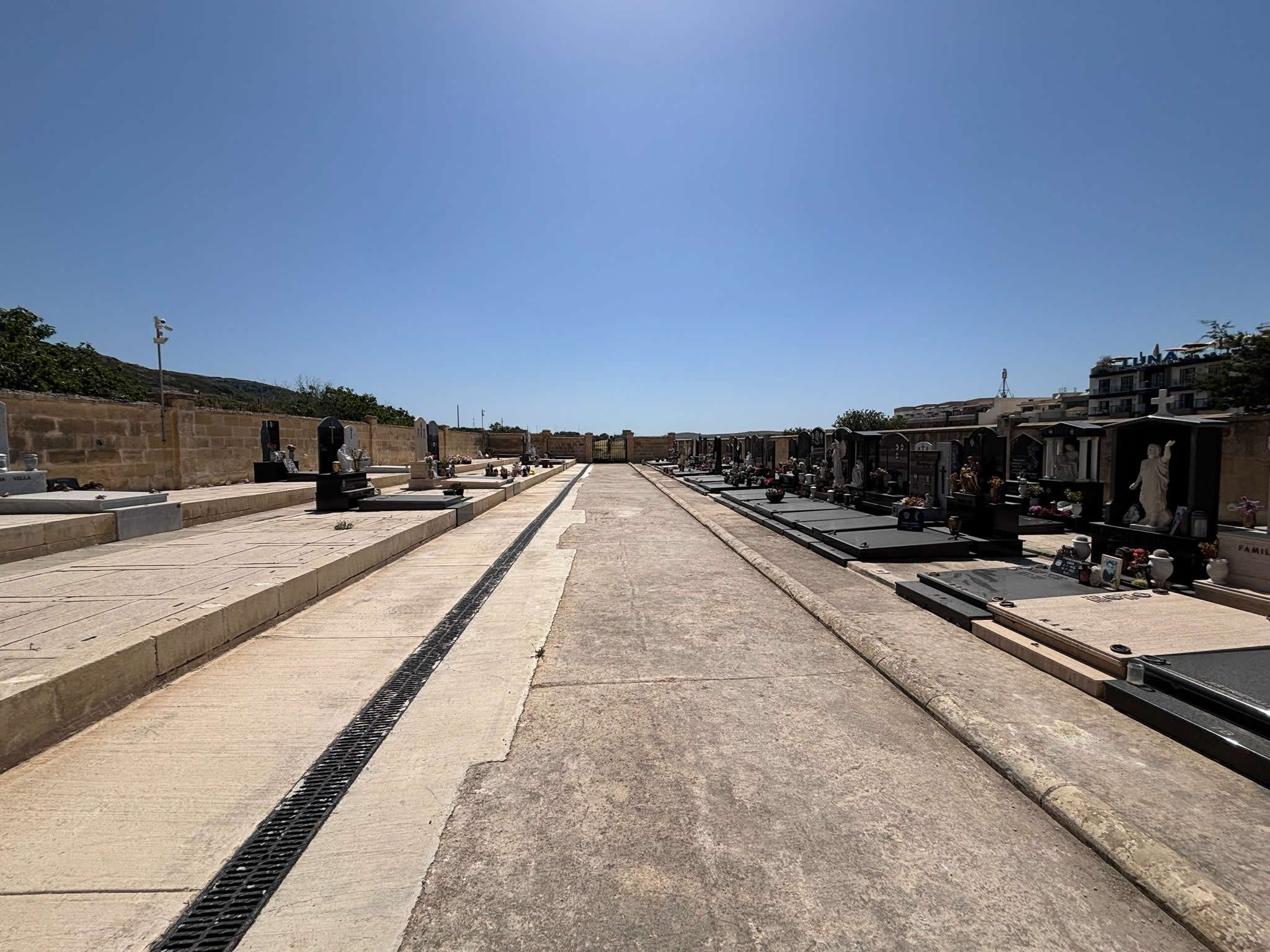
Unlike the ancient, organic, and winding layouts of medieval or baroque-era parish crypts found elsewhere on the islands, the design of Omm il-Ħniena reflects a clean, contemporary architectural style. Built entirely using uniform, machine-cut Maltese globigerina limestone blocks, the facility features a highly structured layout tailored to Mellieħa's naturally sloping terrain.

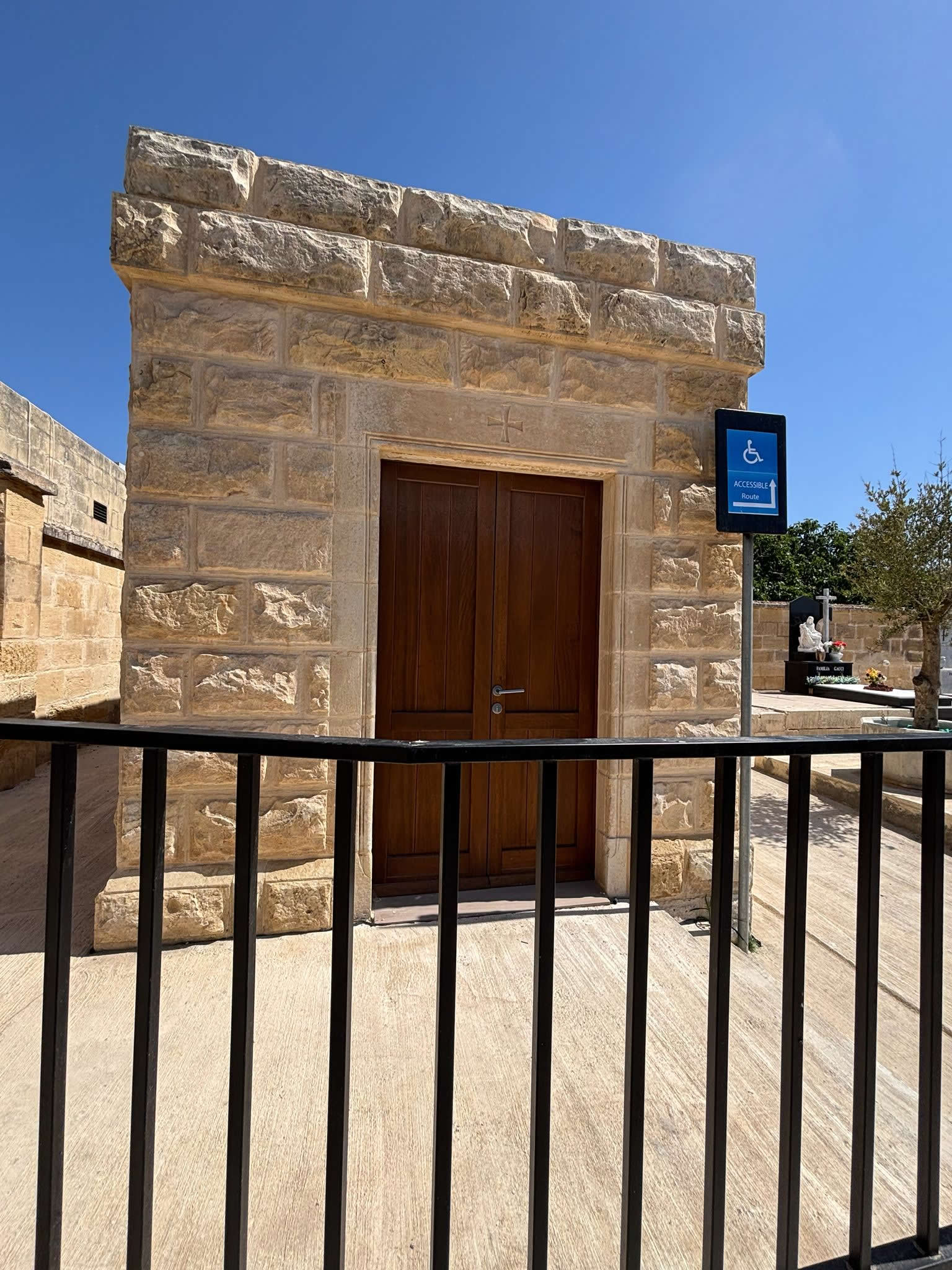
The complex stands out for its extensive terracing system. Engineers used the natural hillside slope to build clear, stepped levels connected by wide, concrete and stone ramps. These pathways are wide enough to accommodate modern funerary equipment and offer full accessibility for disabled visitors. Instead of ornate, varied hand-carved stone monuments, the cemetery emphasizes visual harmony. It utilizes uniform marble markers, clean perpendicular walls, and built-in, recessed planters that blend neatly into the surrounding Mediterranean landscape.
3. State Governance and Public Administration Framework
The administrative structure of the Omm il-Ħniena complex highlights the ongoing modern shift in how public burial spaces are managed across the Maltese islands. The property falls under the direct operational responsibility of the Burials Regulatory Unit, a department within the national Environmental Health Directorate. Consequently, all core administrative functions—including the processing of permanent grave leases, ownership transfers, structural repair permits, and official burial certificates—are managed through state offices and the Burials Administration Unit (BAU) rather than local church authorities.
This state-managed system ensures that the cemetery complies fully with national public health laws, modern environmental codes, and secular civil rights guidelines. At the same time, the state coordinates smoothly with the Mellieħa parish clergy, ensuring that traditional Catholic committal services and final blessings are carried out with dignity at the graveside according to the family's wishes.
4. Internal Topography, Common Spaces, and Functional Design
The interior layout of Omm il-Ħniena is designed to maximize spatial efficiency. The burial grounds are divided into numbered zones arranged along a central axis. Private family plots, multi-tier underground vaults, and common municipal graves are laid out in a precise grid system that allows for easy maintenance and location tracking.
A central gathering area features a prominent, minimalist stone monument that serves as a non-denominational altar space during outdoor commemorative ceremonies. Unlike older churchyards that often have dark, underground common bone pits (ossuaries), Omm il-Ħniena relies on clean, above-ground stone chambers and orderly common plots. These spaces are carefully managed to meet modern sanitation standards and environmental controls, reflecting the best practices of 21st-century civic engineering.

5. Structural Preservation, Modern Extensions, and Ongoing Maintenance
Because Omm il-Ħniena is a modern development, its preservation challenges differ significantly from those of old medieval shrines. Rather than restoring ancient, eroding limestone carvings or cleaning centuries-old soot from interior walls, work at this site focuses on preventative engineering and structural upkeep.
The main maintenance challenges stem from the site's open, hillside location, which exposes it to strong winds, intense summer heat, and heavy winter rains. The Burials Regulatory Unit oversees regular upkeep, which includes checking the stability of the concrete retaining walls, maintaining the drainage networks to prevent water accumulation in lower graves, and cleaning the limestone facing. Over the years, the government has carried out targeted expansion projects within the boundary walls, adding new rows of pre-cast concrete vaults and updating the walkways to ensure the facility can continue to serve the growing population of Mellieħa efficiently.
6. Technical and Administrative Dataset Profile
The data profile below provides a clear summary of the verified geographical, legal, and functional parameters of the Mellieħa municipal facility:
| Administrative Survey Parameter | Field Inventory Reference Data |
|---|---|
| Official Nomenclature | Omm il-Ħniena Cemetery (Our Lady of Mercy Cemetery) |
| Common Local Names | Mellieħa New Cemetery / Mellieħa Municipal Cemetery |
| WGS84 Reference Grid | 35.965391 Latitude, 14.360202 Longitude |
| Ownership & Administration | Government-Run / Managed by the Burials Regulatory Unit |
| Operational Status | Fully Active / Open for Public Municipal Interments |
| Primary Construction Material | Machine-Cut Maltese Globigerina Limestone & Reinforced Concrete |
| Architectural Character | Contemporary Minimalist Grid with Stepped Terracing |
| Administrative Contacts | Burials Administration Unit (BAU) / Mellieħa Local Council |

7. Frequently Asked Questions (FAQ)
❓ How do I apply for a grave lease or request records for Omm il-Ħniena Cemetery?
Because this is a state-owned civic facility, all administrative requests—including grave applications, lease changes, and records searches—must be submitted directly to the national Burials Administration Unit (BAU) rather than the local parish office.
❓ Is the Omm il-Ħniena Cemetery restricted to specific religious denominations?
No, as a government-run municipal cemetery, it serves the entire public in accordance with civil law. It provides fair, standardized access for all citizens while fully accommodating traditional Catholic committal rites requested by families.
❓ Is the facility accessible for visitors with limited mobility?
Yes, the modern design of the cemetery intentionally addresses accessibility. The terraced levels are connected by wide concrete and stone ramps, making it much easier for wheelchairs and strollers to navigate compared to older, historic Maltese churchyards.
❓ What construction materials are used across the terraces?
The cemetery is constructed using durable, machine-cut local globigerina limestone blocks for the outer walls and facing, reinforced with modern concrete core structures to create stable, long-lasting retaining terraces along the hillside.